Claude code has been the go-to model and agentic system for development for a while now. So when Google launched Antigravity alongside Gemini 3 with all the hype, we figured it was the right time to put both systems to a real SOTA (State Of The Art) test.
I sat down with our CTO, Jeyaraj, for a focused 40‑minute conversation on how these two models actually behave in real engineering work. This wasn’t theoretical. It was based on a production module he built using both systems, a module that went from idea to production in just 20 hours.
Prefer watching over reading? Here’s the full SOTA comparison:
Production Build : A scalable and self-improving HubSpot → S3 ETL Module
Jeyaraj picked a real module we are now re‑building due to growing customer demand — a HubSpot → S3 data sync service that needs to handle large datasets, parallel processing, rate limits, memory constraints, and clean handoffs to other microservices.
Benchmarks can tell you how fast a model writes code. They don’t tell you how it behaves when an API fails, or when memory pressure hits, or when the system doesn’t act the way the code suggests it should. That’s the gap we wanted to test.
— Prasanna V. CEO, Petavue
Our expectation was simple: Produce a production-grade module, end-to-end, the way a solid engineer would.
The requirements were straightforward but demanding:
- Export HubSpot objects that can exceed 500K rows.
- Handle multi-GB payloads without blowing through memory limits.
- Stream, chunk, and upload data using S3 multipart uploads.
- Optimize for Lambda/EC2 constraints.
- Retry intelligently on token expiry or rate limits.
- Integrate cleanly with other services that depend on the final output.
- Avoid silent failures, race conditions, or incorrect status updates.
This is the kind of work that exposes weaknesses fast. If an agentic system struggles with architecture, planning, or foresight, it shows.
Side-by-Side Analysis: Across 5 Engineering Dimensions
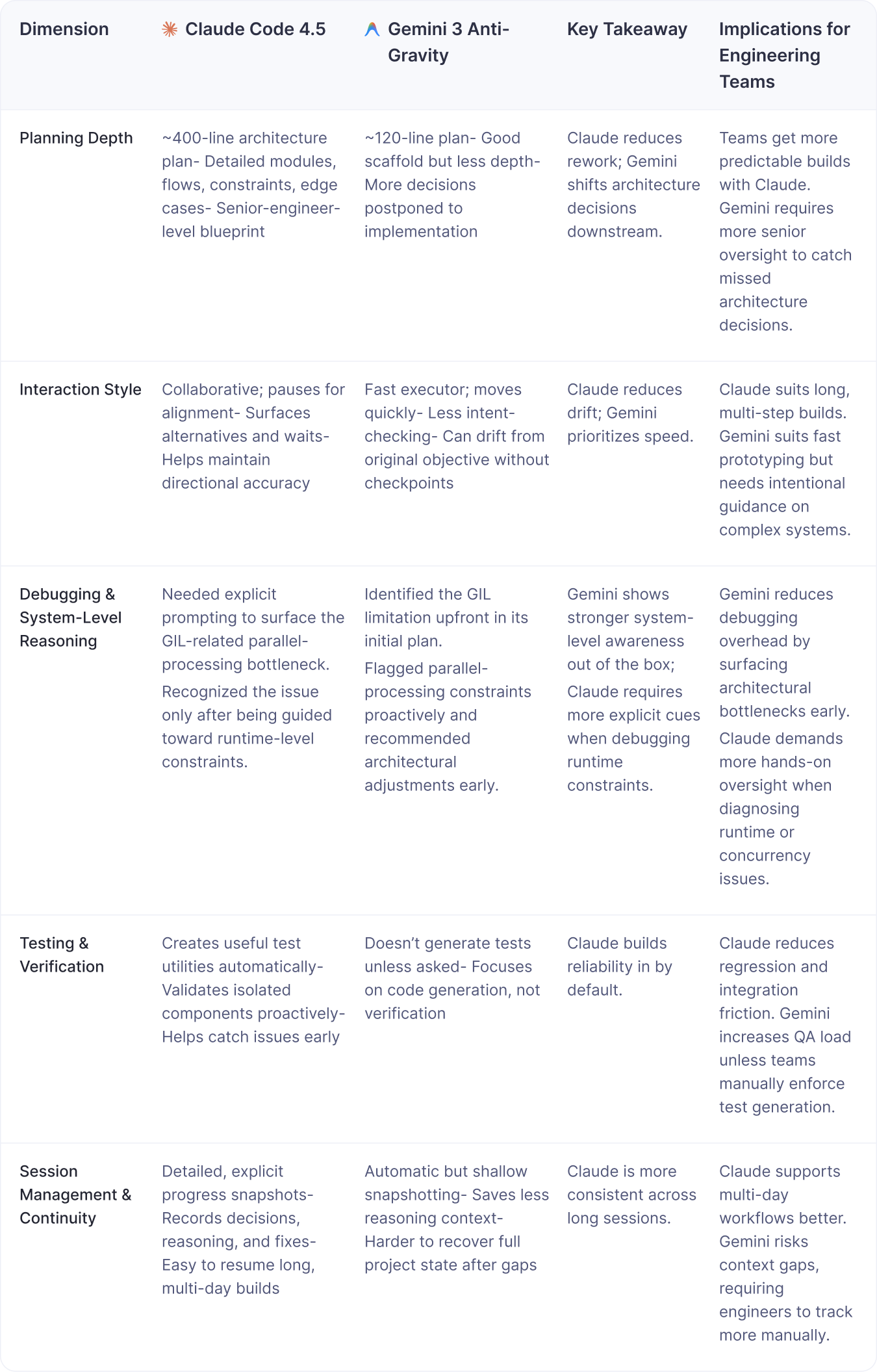
Once we put both systems against the demands of a real production build, the practical differences between Claude Code and Gemini 3 Antigravity weren’t about speed; they were about engineering philosophy.
Both can generate code. Both can scaffold quickly. But their approach to planning, reasoning, and iteration is fundamentally different. And those differences determine whether you ship a reliable product or a brittle liability.
Here’s a side-by-side assessment of where each system stood.
The Cost of Speed: Claude’s Foresight vs. Gemini’s Iteration
Across every engineering dimension, from initial planning to session continuity, both models proved capable but not interchangeable.
Claude Code approached the work with structure and alignment, reducing the critical, high-cost downstream corrections. Gemini moved faster and handled scaffolding well, but its velocity created a higher demand for explicit direction and deep-seated reasoning from the engineer.
Claude gave me a 400-line architecture plan before it wrote code. File structure, data flows, error paths, concurrency strategy — everything. It was detailed enough that you knew the implementation would go smoothly.
— Jeyaraj, CTO, Petavue
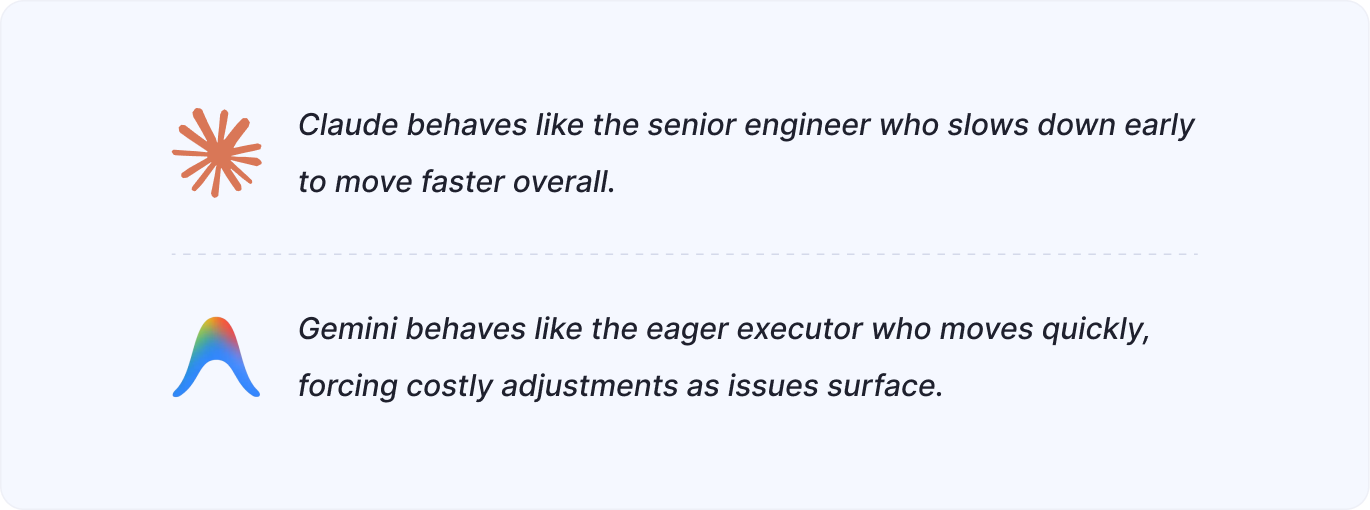
The difference is stark:
Gemini is impressive when you want speed. But when the system has real edge cases and integrations, speed without alignment just means more iteration later.
— Prasanna V. CEO, Petavue
In a serious build, the true bottlenecks aren’t syntax or typing. They are reasoning, validation, and aligning components under real constraints.
A module that might take a senior engineer 2-3 weeks was completed in about 20 hours. The acceleration is undeniable.
A module like this would take a junior engineer 5 weeks. A solid senior, maybe 2-3 weeks. With AI, the entire thing came together in about 20 hours.
— Jeyaraj, CTO, Petavue
But here’s the key: The job didn’t disappear, it reorganized.
We stopped writing lines of code. We started spending all our time:
- Defining Intent
- Validating Architecture
- Correcting Edge Cases
- Ensuring Iterations Stay Aligned
AI handles the mechanical work; the engineer owns the verified reasoning and decision-making.
To Summarize
Claude felt steadier and more structured, reducing friction in our critical validation loops. Gemini felt energetic and reactive, forcing us to constantly course-correct.
The conversation shouldn’t be focused on “Who’s louder?” or “Who’s the new incumbent?” It should be: Which system helps you move from intent to working code with the fewest unnecessary steps?
The systems that win will be the ones that move correctly with less supervision, not the ones that produce the most lines of code per minute. That is the mandate of the next era of AI engineering. The future is already here, but it still requires the engineer to think, verify, and lead.
Frequently asked questions
Claude Code 4.5 tends to perform better for serious engineering work because it produces deep architectural plans, anticipates edge cases, and maintains alignment throughout multi-step builds. It behaves more like a senior engineer, creating a detailed blueprint before implementation. Gemini 3 Antigravity is fast and capable, but it defers many architectural decisions until later, which can introduce downstream rework in production environments. Both can generate code, but Claude delivers more predictable and stable outcomes when building systems with real constraints.
Claude demonstrates stronger system-level reasoning. It can identify root causes from partial context, interpret runtime behavior, and adjust architecture with minimal prompting. Gemini typically needs more explicit guidance to diagnose issues and correct logic. When APIs fail, memory pressure spikes, or concurrency problems appear, Claude reduces debugging overhead while Gemini requires more step-by-step direction to stay on track.
Claude Code 4.5 is generally better for complex, high-scale systems. It handles architectural reasoning, concurrency planning, rate limits, retries, and data-flow design with more foresight. Tasks like exporting 500K+ rows, chunking multi-GB payloads, orchestrating S3 multipart uploads, and managing service-to-service dependencies benefit from Claude’s structured approach. Gemini is fast at scaffolding but needs more oversight to avoid misaligned architecture or missed edge cases in distributed flows.
Claude maintains long-session continuity more reliably. It captures decisions, progress snapshots, and reasoning steps in detail, making it easier to resume multi-day builds without re-explaining the project. Gemini saves context, but at a shallower level — meaning key reasoning and design choices may need to be reintroduced after breaks. This makes Claude the more dependable choice for extended workflows where consistency matters.
Yes. Gemini 3 Antigravity excels in speed and rapid iteration. It generates scaffolds quickly and is ideal for early concepts, prototypes, or situations where the objective is to produce something fast rather than structurally perfect. The tradeoff is that its speed can create drift from the original intent, requiring additional corrections later. Claude moves slower upfront but reduces the amount of rework needed for production-level builds.
Claude Code 4.5 prioritizes structure, reasoning, validation, and alignment — qualities that lead to fewer friction points in the overall engineering lifecycle. Gemini 3 Antigravity prioritizes speed and execution but assumes more guidance from the engineer. In practice, Claude behaves like a senior engineer ensuring long-term stability, while Gemini behaves like a fast executor who benefits from checkpoints and direction. The choice depends on what’s more important: reliability under complexity or velocity during exploration.